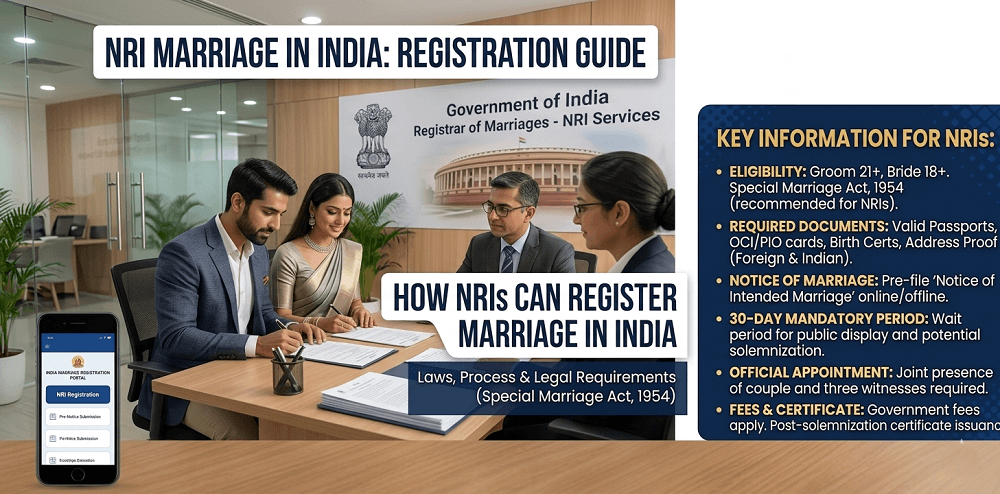
How NRIs Can Register Marriage in India: Laws, Process & Legal Requirements
NRI Marriage Registration in India
Non-Resident Indians (NRIs) can legally register marriage in India under personal laws such as the Hindu Marriage Act, 1955, or under civil provisions like the Special Marriage Act, 1954.
An official Indian marriage certificate is important for spouse visa applications, immigration procedures, passport updates, overseas banking, insurance claims, and international legal documentation.
Legal Frameworks for NRI Marriage Registration
NRIs can register marriage in India through different legal frameworks depending on religion, nationality, and marriage preferences.
1. Hindu Marriage Act, 1955
This Act applies when both parties are Hindus, Sikhs, Jains, or Buddhists. The marriage must first be solemnized through traditional religious rituals before registration.
Registration under the Hindu Marriage Act is generally faster because there is no mandatory public notice period before registration.
2. Special Marriage Act, 1954
The Special Marriage Act is applicable for interfaith marriages, court marriages, or marriages involving foreign nationals.
Couples registering under this Act must complete a mandatory 30-day public notice period before the marriage can be solemnized by the Marriage Officer.
Documents Required for NRI Marriage Registration
Proper documentation is essential for successful NRI marriage registration approval in India.
Identity & Immigration Documents
- Valid Passports of both parties
- Visa copies or OCI/PIO documents
- Permanent Residency or Work Permit documents if applicable
Residential Proof
- Registered Rent Agreement
- Utility Bills
- Local Residence Certificate
- Hotel Stay Proof if applicable
Mandatory Legal Documents
- Single Status Certificate or No Objection Certificate (NOC)
- Divorce Decree if previously married
- Death Certificate of previous spouse if widowed
- Apostilled foreign documents where applicable
Marriage & Witness Documents
- Wedding invitation card
- Joint passport-size photographs
- Marriage ceremony photographs
- Identity proof of three witnesses
Hindu Marriage Act vs Special Marriage Act
| Feature | Hindu Marriage Act | Special Marriage Act |
|---|---|---|
| Applicability | Hindus, Sikhs, Jains, Buddhists | All religions and nationalities |
| Marriage Ceremony | Religious ceremony required | Civil marriage before Marriage Officer |
| Notice Period | No mandatory notice | 30-day public notice |
| Ideal For | Traditional religious marriages | Interfaith or court marriages |
| Processing Timeline | Faster registration process | Longer due to notice period |
Step-by-Step NRI Marriage Registration Process
Special Marriage Act Process
- Submit Notice of Intended Marriage
- Complete mandatory 30-day notice period
- Clear public objection period
- Attend registrar office with witnesses
- Sign marriage declaration before Marriage Officer
- Receive official marriage certificate
Hindu Marriage Act Process
- Complete traditional marriage ceremony
- Submit registration application form
- Verify original passports and legal documents
- Appear before registrar with witnesses
- Complete biometric verification
- Receive marriage registration certificate
Why Professional Legal Assistance is Important
NRI marriage registration often involves embassy documentation, apostille verification, legal compliance, and travel timeline coordination.
Professional legal consultants help avoid document rejection, appointment delays, incorrect paperwork, and registration complications while ensuring smooth processing.
- Document verification support
- Apostille and embassy guidance
- Verification appointment management
- Legal compliance assistance
- Faster registration process coordination
Frequently Asked Questions
Yes. NRIs can legally marry foreign nationals in India under the Special Marriage Act by submitting valid passports, visas, and No Objection Certificates.
Yes. A Single Status Certificate or No Objection Certificate is mandatory to confirm the applicant is legally unmarried.
No. The Special Marriage Act legally requires a mandatory 30-day public notice period before solemnization.
Yes. Foreign-issued legal documents must be apostilled or attested by the Indian Embassy before submission in India.