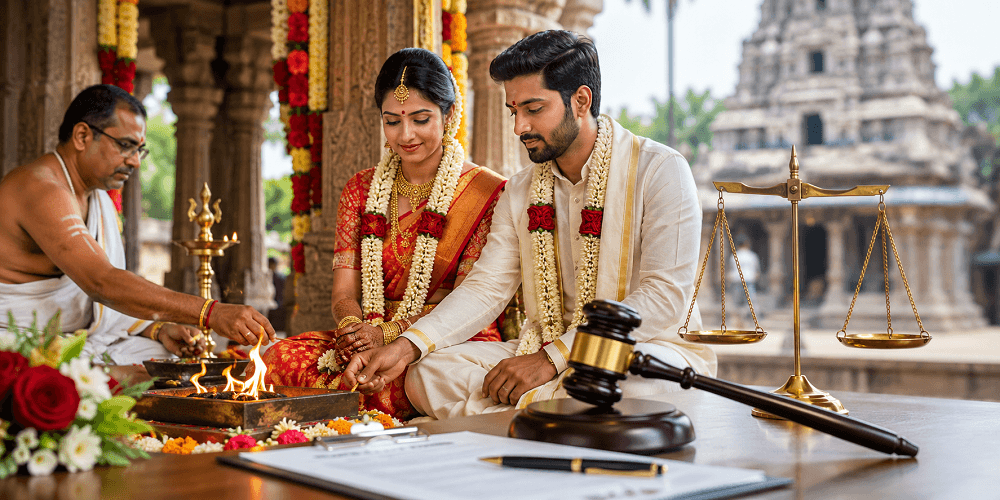
Is Temple Marriage Legally Valid in Pune? Complete Registration Process Explained
Traditional weddings in places of worship hold deep spiritual value for many families. However, couples often overlook the legal framework necessary to protect their marital rights under Indian law. If you have recently solemnized your wedding in a religious place or are planning one, understanding the structural rules of legal compliance is critical.
This comprehensive guide breaks down the statutory rules, verification steps, and documentation requirements needed to convert a traditional religious ritual into a legally recognized union within the Pune Municipal Corporation (PMC) and Pimpri Chinchwad Municipal Corporation (PCMC) jurisdictions.
Understanding the Legal Validity of Temple Marriage in India
A common misconception among couples is that performing traditional rituals and obtaining a certificate from a religious institution completes the legal process. Under statutory frameworks, a religious ceremony only satisfies customary practices but does not grant automatic structural legal protection. To secure your legal rights, utilizing a dedicated professional service for Temple Marriage with Registration ensures that your religious ceremony is fully supported by an enforceable government certificate.
Statutory Provisions for Religious Weddings
The legal validity of temple marriage in India is primarily governed by the Hindu Marriage Act, 1955. While Section 7 of the Act recognizes traditional ceremonies like Saptapadi (seven steps around the sacred fire), Section 8 clearly empowers State Governments to make rules regarding the registration of these marriages.
The Honorable Supreme Court of India, in the landmark judgment of Seema v. Ashwani Kumar (2006), made marriage registration mandatory across all Indian states to prevent legal ambiguities, safeguard women's rights, and prevent issues like bigamy.
Key Legal Realities of Mandir Rituals
- Ceremony vs Certificate: A receipt or certificate issued by a trust or a priest has no statutory value in government departments, passport offices, or courts.
- Evidentiary Requirement: In the absence of a government registration, proving a marriage during legal disputes, immigration processes, or inheritance claims becomes extremely difficult.
- The Compulsory Act: In Maharashtra, the Regulation of Marriage Act, 1998, explicitly mandates that every wedding performed within the state boundaries must be registered within a specified timeline.
| Aspect | Temple Religious Ceremony | Government Marriage Registration |
|---|---|---|
| Primary Authority | Religious Trust, Priest, or Mandir Management | Sub Registrar Office / Municipal Authority |
| Legal Status | Socially and Culturally Valid | Statutorily and Legally Binding |
| Document Issued | Marriage Receipt or Unofficial Certificate | Official Government Marriage Certificate |
| Global Acceptance | Not accepted for visas, passports, or joint bank accounts | Universally accepted by all global and domestic authorities |
Temple Wedding Legal Procedure Maharashtra: Eligibility Criteria
Before applying under the temple wedding legal procedure maharashtra, couples must ensure they meet the strict statutory eligibility conditions. The local bodies in Pune thoroughly verify these parameters during the physical application screening.
Essential Eligibility Conditions
- Minimum Age Limit: The groom must have completed 21 years of age, and the bride must have completed 18 years of age at the time of the wedding rituals.
- Consent of Parties: Both individuals must give free, valid consent. Neither party should be incapable of giving valid consent due to an unsound mind.
- Monogamy Rule: Neither party must have a living spouse at the time of the religious ceremony. If either party was previously married, a legal divorce decree or a valid death certificate of the former spouse is mandatory.
- Degrees of Prohibited Relationship: The couple must not fall within the degrees of prohibited relationship or be Sapindas of each other, unless local custom or usage governing each party permits such a wedding.
How to Register a Temple Marriage in Pune: Step-by-Step
The structural process to register marriage after traditional wedding pune involves specific interactions with the local administrative bodies. For couples who prefer a purely administrative, non-religious process from the very beginning, transitioning into a Hindu Court Marriage Registration bypasses temple rituals completely and legalizes the union directly under the oversight of a government marriage officer.
Step 1: Pre Registration Documentation and Slot Booking
Couples must compile all required identity proofs, age proofs, and photographs of the mandir wedding rituals. The initial application must be initiated online through the official Maharashtra government portal (MahaOnline) or the Pune Municipal Corporation website, where details regarding the location of the wedding and personal data are recorded to secure a physical verification date.
Step 2: Physical Verification at the Office
On the scheduled date, the couple, along with three witnesses, must visit the designated administrative office. This is typically the sub registrar office temple marriage registration or the local ward office of the Pune Municipal Corporation. The marriage registrar verifies the original documents against the submitted online application to ensure no statutory rules are breached.
Step 3: Biometric Data Capture and Signing
During the physical appearance, the biometric data (fingerprints and digital signatures) of the husband, wife, and three witnesses are captured in the government registry system. The registrar records the statements of the witnesses who testify that they were present during the traditional mandir wedding rituals.
Step 4: Issuance of the Official Certificate
Once the verification is successful and the entry is recorded in the state register, the official document is generated. The final marriage certificate after temple rituals pune is generally issued within a few working days, featuring a unique registration number, state seal, and digital signatures of the registrar.
Comprehensive List of Documents Required for Temple Marriage Registration Pune
To ensure a smooth approval process without administrative delays, you must prepare a robust document file. All copies must be self attested, and originals must be produced during the physical verification.
Exhaustive List of Required Documents
- Application Form: Completely filled and signed Form A under the Maharashtra marriage rules.
- Age Proof of Both Parties: School Leaving Certificate, Birth Certificate, Passport, or PAN Card.
- Address Proof: Aadhaar Card, Passport, Voter ID Card, Electricity Bill, or Registered Rent Agreement reflecting residence within Pune jurisdiction for more than 30 days.
- Wedding Evidence: Invoice or certificate issued by the mandir trust, wedding invitation card, and three distinct photographs showing the couple performing the key wedding rituals (such as Saptapadi or Jaimala).
- Witness Documentation: Aadhaar Card, PAN Card, and passport size photographs of exactly three witnesses who attended the wedding ceremony.
- Marital Status Proof: Divorce decree if either party is a divorcee, or a death certificate if either party is a widower or widow.
| Sl No | Document Category | Acceptable Options (Any One) | Purpose |
|---|---|---|---|
| 1 | Proof of Age | Birth Certificate, Passport, Leaving Certificate | Verifies compliance with the legal age limit |
| 2 | Proof of Residence | Voter ID, Aadhaar Card, Electricity Bill | Confirms territorial jurisdiction in Pune |
| 3 | Wedding Proof | Mandir Certificate, Invitation Card, Ritual Photos | Validates that actual rituals took place |
| 4 | Witness Identity | PAN Card, Aadhaar Card, Driving License | Establishes the legality of the third party testimony |
Arya Samaj Marriage Certificate Validity Pune: Special Focus
Many couples choose Arya Samaj temples due to their simplified rituals and quick processes. However, understanding the legal standing of these specific institutions is highly critical.
The Legal Framework for Arya Samaj
The arya samaj marriage certificate validity pune is recognized under the Arya Samaj Marriage Validation Act, 1937, read alongside the Hindu Marriage Act, 1955. An Arya Samaj temple conducts weddings strictly according to Vedic rituals, focusing on simplicity and the elimination of elaborate social customs.
Important Legal Conditions
- The Supreme Court Ruling: The Supreme Court of India clarified that an Arya Samaj temple has no legal authority to issue a valid marriage certificate that replaces a government document. The temple certificate only serves as an internal proof of ritual completion.
- Mandatory Government Steps: To make an Arya Samaj wedding legally secure, the couple must take the temple certificate to the local municipal ward officer or the court registration for mandir marriage pune authorities to obtain a formal state government certificate.
Official Fees and Structural Timelines in Pune
Understanding the financial and time investments required for registration helps couples plan their applications efficiently without falling prey to unauthorized middlemen.
Government Fee Breakdown
The standard government application fee for registering a wedding in Pune is highly economical. The basic registration fee generally ranges between fifty rupees to two hundred rupees depending on whether the application is processed under the state specific municipal acts. Additional online portal processing fees and stamp duties may apply during the transaction.
Expected Timeframes
- Standard Processing Window: After successful physical document verification at the ward office, it usually takes seven to fifteen working days to generate the certified copy.
- The Tatkal Route: For urgent requirements, the government offers an expedited route where applications are processed on a fast track basis, allowing the certificate to be generated within twenty four to forty eight hours upon payment of an additional expedited processing fee.
Key Structural Variations: Ward Office vs Sub Registrar Office
Couples are often confused about where exactly they should submit their files in Pune. The correct administrative path depends entirely on the timing and the explicit act chosen for registration.
Registration via Pune Municipal Corporation Ward Offices
If the registration is being processed under the local Maharashtra Regulation of Marriage Act, 1998, for a wedding that has already been solemnized via traditional rituals, the application goes to the local Ward Officer (acting as the Registrar of Marriages) of the PMC or PCMC under whose jurisdiction the wedding took place or where the couple resides.
Registration via the Sub Registrar Office
For couples utilizing the steps to legalise a temple wedding pune under specific sections of the Hindu Marriage Act, 1955, or where explicit property, inheritance, or high level foreign immigration verifications are expected, the application is systematically processed through the Joint Sub Registrar offices located at various administrative hubs across Pune district.
Top Challenges and Errors in Temple Marriage Registration
Many applications face sudden rejections or long administrative delays due to minor documentation errors or structural non compliance with the temple marriage registration rules pune.
Common Mistakes to Avoid
- Spelling Discrepancies: Name mismatches between the school leaving certificate, Aadhaar card, and wedding invitation card will cause immediate application halts. Ensure all spellings are completely uniform across your document set.
- Inadequate Photo Evidence: Submitting generic couple portraits instead of photos clearly showcasing the specific mandatory rituals like the exchange of garlands or the Saptapadi can lead to verification failures.
- Witness Absences: Choosing witnesses who fail to produce original PAN cards or who cannot attend the physical slot appointment will break the verification pipeline.
- Delayed Submissions: Failing to apply within the mandated ninety day window from the date of the traditional rituals can result in fines and require special condonation approvals from higher municipal authorities.
Conclusion and Strategic Legal Assistance
Securing a government document after traditional rituals is the only way to establish the legal validity of temple marriage in India. Managing the strict timelines and municipal documentation on your own can easily lead to unnecessary administrative delays or application rejections at the sub registrar office temple marriage registration.
If you want to skip the stress of complex local paperwork and endless government office queues, professional support can simplify your entire timeline. Our experienced on-ground team handles everything from initial profile verification to structural slot bookings. Connect with our experts at Marriage Registration in Pune to streamline your official documentation and secure your government marriage certificate smoothly.
Frequently Asked Questions (FAQs)
No, foreign embassies do not recognize a certificate issued by a religious institution or mandir trust. You must present an official marriage certificate issued by a municipal corporation or a sub registrar office to process visa applications.
You can still register your wedding, but it will attract a late penalty fee. The file may also undergo a more rigorous verification process by the local ward officer or registrar to confirm the validity of the delay.
No, it is not mandatory. The three witnesses can be any adult individuals who possess valid identity proofs and address proofs, and who were physically present during the wedding rituals. They can be friends, neighbors, coworkers, or family members.
Any official certificate issued by the Pune Municipal Corporation or the Maharashtra government features a unique registration number and a verifiable QR code. Scanning the QR code links directly back to the government database to confirm authenticity.
No, while the data entry, document upload, and slot booking happen completely online, the physical presence of both spouses and all three witnesses at the office is absolutely mandatory to capture biometric data and execute signatures.